How it Works
AI is finally smart enough to help with high-stakes people decisions. Context is the missing layer, and Windmill is building it.
First 10 users free, forever
The stakes
People decisions have always mattered.
Now they move faster than ever.
Companies can no longer get by on manager intuition, scattered systems, and memory. Every week, leaders face high-context judgment calls like these:
Who should lead this project?
Who is in the wrong role?
Who is ready for more scope?
Who needs coaching?
Where is the organization quietly breaking down?
Who deserves a promotion this cycle?
Who should lead this project?
Who is in the wrong role?
Who is ready for more scope?
Who needs coaching?
Where is the organization quietly breaking down?
Who deserves a promotion this cycle?
Who is at risk of leaving?
Who has the most context on this?
Whose growth has stalled?
Which team is quietly carrying the org?
Who should mentor the new hires?
Who is overloaded right now?
Who is at risk of leaving?
Who has the most context on this?
Whose growth has stalled?
Which team is quietly carrying the org?
Who should mentor the new hires?
Who is overloaded right now?
These are all judgement calls. To be useful, AI needs more than intelligence; it needs a system of context.
The graph
Four layers of context
People provide the structure. Evidence supplies the facts. Standards define the rubric. Perspectives shape the interpretation. Without all four, you're left with an incomplete picture.
Layer 1
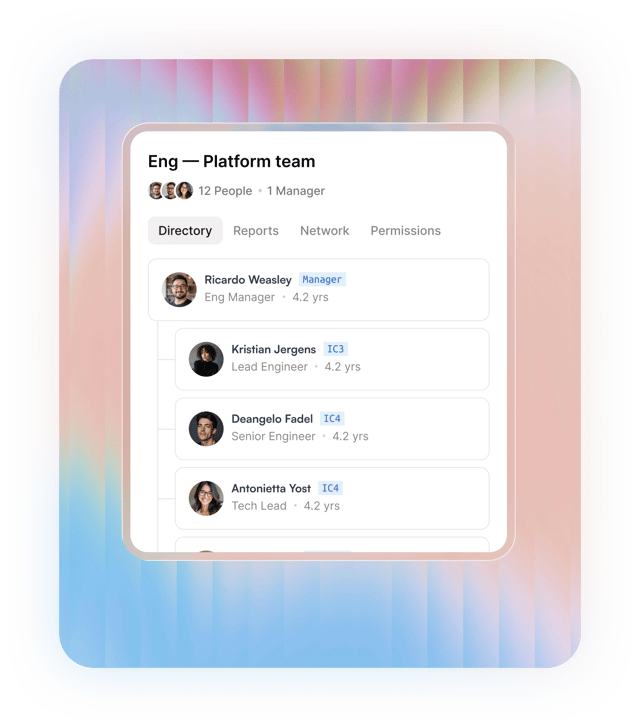
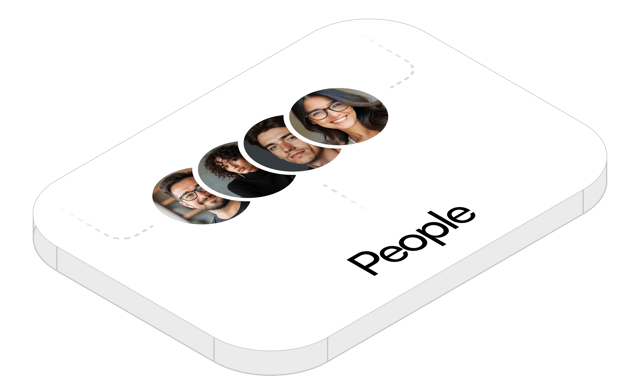
Who works here, and who works together
The foundation: who someone is, and how the org actually flows.
- Roles, reporting lines, tenure, permissions — the structure, kept current from your HRIS.
- The real organizational network: who actually collaborates, derived from how work flows over time.
- Permission-aware. Mirrors every tool's access rules so nothing is surfaced to anyone who shouldn't see it.

Layer 2
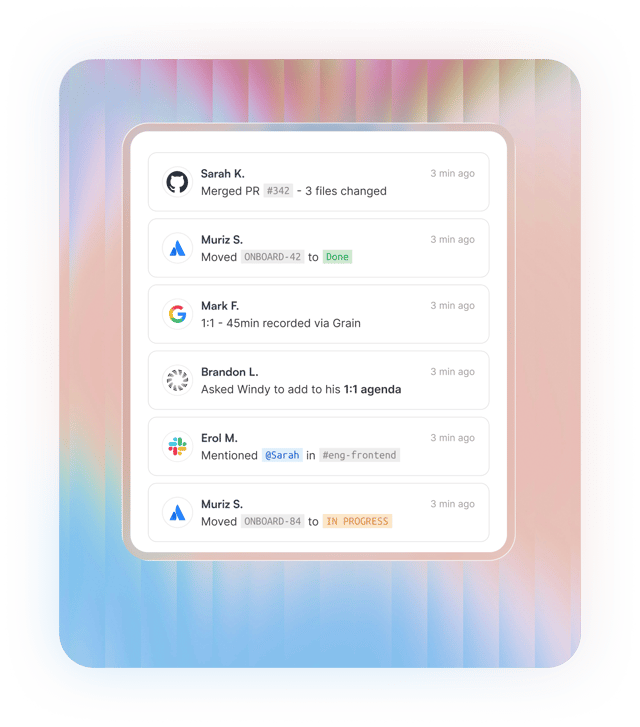
What actually happened
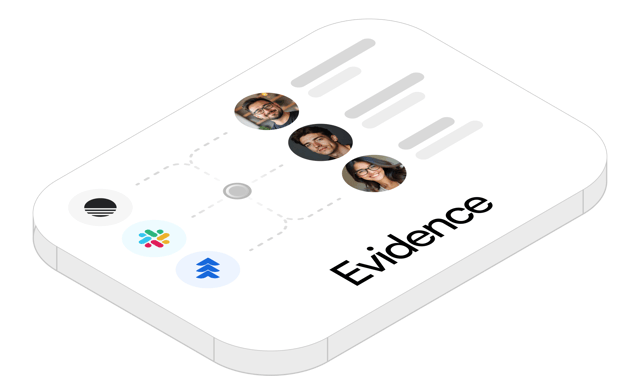
The ground truth of work over time, connected to the right people.
- Pulled from where work already lives: GitHub, Linear, Slack, Salesforce, calendars, docs.
- Connected to the right people, preserved in history, and kept up to date.
- Surface-level integrations don't make a useful graph. Evidence has to understand workflows, ownership, and how work changes over time.
Layer 3
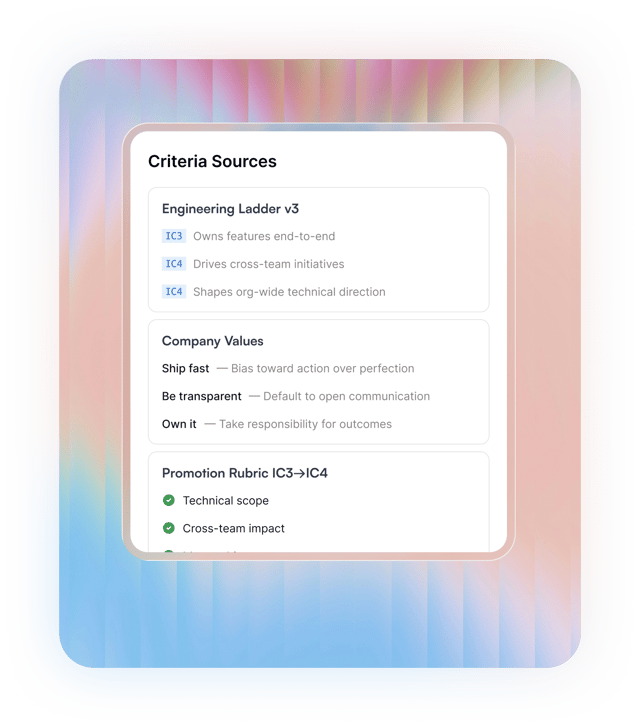
What great looks like
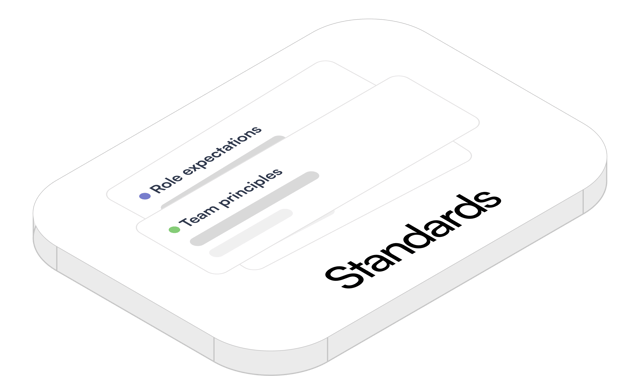
The rubric that turns raw activity into meaning.
- Role expectations, goals, team priorities, company values, operating principles.
- How this team actually evaluates tradeoffs, what behaviors are rewarded, what success looks like in practice.
- Without standards, evidence is just activity — busy doesn't mean aligned.
Layer 4
What informed humans think it means
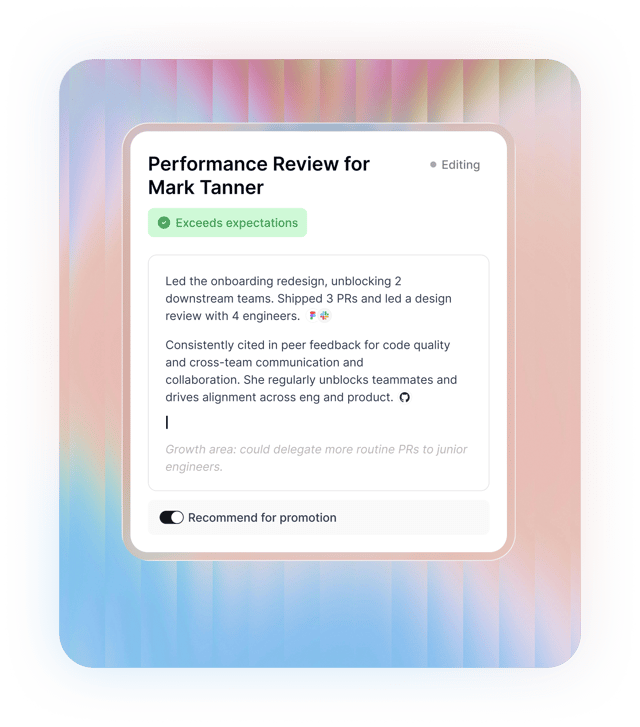
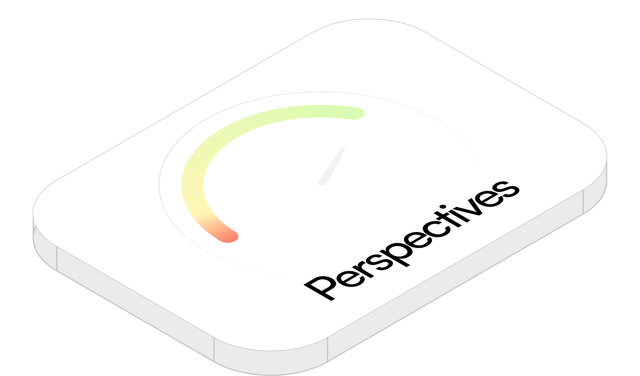
The observations managers and peers carry in their heads.
- Feedback, private notes, 1:1s, and manager observations that never make it cleanly into a record.
- Captured in low-friction ways. Meets people where they already work.
- Permission-governed and connected to the right people and events, surfaced only when needed.
Why nothing else solves this
Every company has fragments. Almost none have the graph.
Who someone is. Not what they worked on.
What moved. Not what was expected.
The important observations, never written down.
Forms at review time. No living model underneath.
Each of these holds a fragment of the picture. None of them assembles it. Existing performance tools collect inputs at review time. They don't build and maintain a living model of your people. And a generic LLM can synthesize whatever you hand it, but it can't build and maintain this context for you.
It's like having a second brain that specializes in organization and recall. It's amazing.

What Windmill does
We build the graph. You make the decisions.
Windmill collects, structures, and maintains work context from the systems teams already use. It turns scattered data and human input into a continuously updated, permission-aware context graph.
Performance reviews are the first proof point, but not the endpoint.
Windmill took me from three hours per person to about half an hour. It felt like someone was brainstorming with me on improvement points.

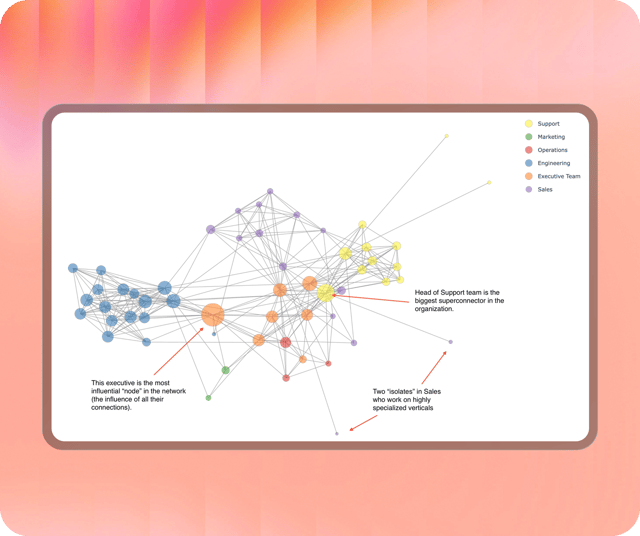
Once the graph exists, many other workflows become possible: staffing decisions, promotion cases, coaching recommendations, succession planning, and organizational diagnostics. The review is one expression of the graph. It will not be the last.